
Insurance verification has always been one of the most time-consuming tasks in a dental practice.
Front desk teams spend hours:
- Calling insurance providers
- Checking eligibility portals
- Manually entering coverage details
And despite all that effort, errors still happen.
In 2026, dental practices are no longer treating insurance verification as a manual task. They are turning to AI to make it faster, more accurate, and far less dependent on repetitive human work.
This shift is not just about saving time — it directly impacts revenue, patient experience, and operational efficiency.
The Problem with Traditional Dental Insurance Verification
Most dental clinics still rely on manual workflows.
- Staff waiting on hold with insurers
- Switching between multiple portals
- Copy-pasting patient coverage details
- Updating spreadsheets or PMS systems
This creates three major problems:
Time Drain on Front Desk Teams
Insurance verification can take several minutes per patient — sometimes longer for complex cases.
Across a week, this adds up to hours of non-patient-facing work.
High Risk of Errors
Manual processes lead to:
- Incorrect coverage details
- Missed limitations
- Outdated eligibility data
These errors often show up later as:
- Claim denials
- Billing disputes
- Patient dissatisfaction
Delays in Treatment Decisions
When verification is not ready:
- Treatment plans get delayed
- Patients hesitate to proceed
- Scheduling becomes inefficient
What AI Changes in Insurance Verification
AI does not just “speed things up” — it changes how verification is done entirely.
Instead of manual steps, AI systems:
- Retrieve insurance data automatically
- Validate coverage and benefits
- Flag inconsistencies in real time
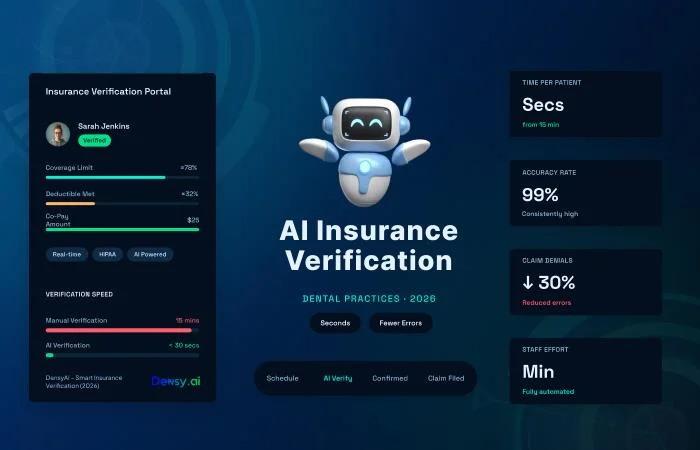
What used to take minutes (or hours) now happens in seconds.
Key Capabilities of AI Insurance Verification
Real-Time Eligibility Checks
AI can verify patient insurance instantly during scheduling.
This allows:
- Immediate confirmation
- Faster booking decisions
- Better patient communication
Automated Data Extraction
AI reads and processes:
- Policy documents
- Coverage limits
- Deductibles and co-pays
No manual data entry required.
Error Detection Before Claims
AI identifies:
- Missing information
- Coverage mismatches
- Potential claim risks
This reduces downstream issues significantly.
Continuous Learning and Improvement
Modern AI systems improve over time by:
- Learning from past verifications
- Adapting to payer-specific formats
- Increasing accuracy with usage
Manual vs AI Verification: A Practical Comparison
| Factor | Manual Verification | AI Verification |
|---|---|---|
| Time per patient | 5–15 minutes | Seconds |
| Accuracy | Variable | Consistent |
| Staff effort | High | Minimal |
| Scalability | Limited | High |
| Error handling | Reactive | Proactive |
Impact on Dental Practice Operations
1. Reduced Administrative Workload
Staff spend less time on repetitive tasks and more time:
- Engaging with patients
- Supporting treatment coordination
2. Faster Revenue Cycle
With fewer verification errors:
- Claims get processed faster
- Denials decrease
- Cash flow improves
3. Better Patient Experience
Patients benefit from:
- Clear cost expectations
- Faster appointment scheduling
- Fewer billing surprises
Still verifying insurance manually?
Explore how automation can reduce errors and save hours every week.
Book a Demo →What to Consider Before Adopting AI
AI insurance verification is powerful — but implementation matters.
Your AI solution should connect with:
- Practice management software (PMS)
- Scheduling systems
Without adding complexity.
Ensure the system is:
- HIPAA-compliant
- Secure in handling patient data
AI works best for routine verification.
For edge cases: Human review should still be part of the workflow.
Common Mistake: Treating Verification as an Isolated Task
Many clinics adopt AI just for verification.
But in reality, verification is part of a larger workflow:
- Patient calls
- Appointment booking
- Follow-ups
- Billing
Looking Ahead: Insurance Verification in 2026 and Beyond
AI is evolving beyond basic automation.
Emerging trends include:
- Predictive verification (anticipating issues before appointments)
- Real-time integration with payer systems
- Fully automated revenue workflows
Dental practices adopting these systems early will operate faster, with fewer errors and better patient outcomes.
Final Thoughts
Insurance verification is no longer just an administrative task.
It is a critical part of the patient journey and revenue cycle.
AI is helping dental practices move from:
- Slow, manual processes
- To fast, reliable, and scalable systems
It’s how soon your practice adopts it.
Want to streamline insurance verification and patient workflows?
See how Densy AI helps dental practices automate verification, calls, and follow-ups — all in one system.
Book a demo today →