
Missed Call Text Back for Dental Offices —
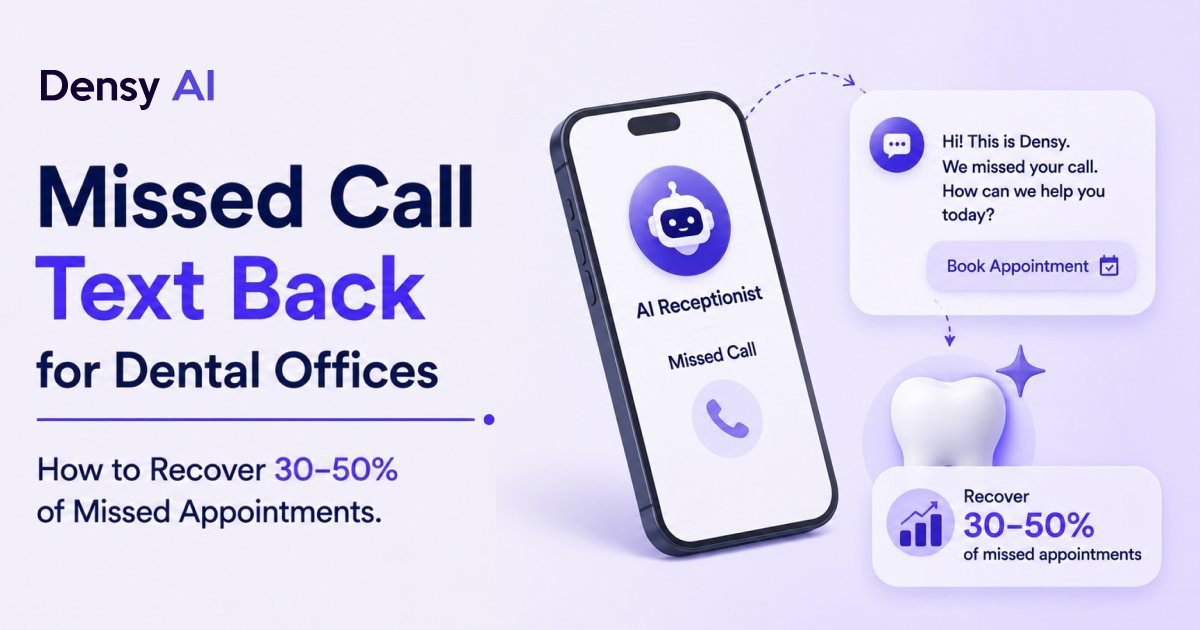
How to Recover 30–50% of Missed Appointments
The front desk at most dental offices runs the same way. Phones ring during patient check-in, during treatment, and all through lunch. Calls get missed. The typical practice loses 35–45% of inbound calls — and 85% of those callers don't leave a voicemail. A missed call text back recovers them automatically, before they call the next dentist on Google.
How Many Calls Your Dental Office Is Actually Missing
The typical single-location dental practice misses 35–45% of inbound calls. That number is consistently higher during peak hours — 11am to 1pm and 4 to 6pm — and after office hours. Front desk staff managing simultaneous check-ins, treatment handoffs, insurance verification, and phone calls cannot realistically answer every call.
Here is what that means in revenue. If your practice books 20 new patients per month from inbound calls and you are missing 35% of those calls, you are losing 7–10 potential new patients every month. At a $1,200 average lifetime patient value, that is $8,400–$12,000 per month — not from poor marketing, but from unanswered phones. The annual compound of that gap is significant for any practice planning growth.
What Happens After a Missed Call
The two scenarios play out very differently — and the gap between them is the difference between a recovered patient and a lost one.
Without a missed call text back
The caller hangs up. 85% do not leave a voicemail. They either call the next dentist on their Google results, or they put off booking entirely. Your practice never knows the call happened.
With a missed call text back
Within 30–60 seconds, they receive a text from your office number:
“Hi! This is Sunrise Dental — sorry we missed your call. We'd love to help. Are you looking to book a new patient appointment, or something else?”
They reply. Your system — or your AI — routes them to a booking link or opens a scheduling conversation. Dental offices using this consistently recover 30–50% of previously missed callers as booked appointments. Most of those callers were ready to book. They just needed someone to respond before they moved on.
The mechanism behind this is simple: speed. The caller is still holding their phone, still thinking about booking. A text that arrives in 60 seconds catches them in that moment. A voicemail they discover two hours later — or a callback that comes in during their next meeting — does not. For more on why timing drives recovery rate, see the full guide to how missed call text back works.
Where Missed Calls Happen Most in a Dental Practice
The miss pattern at most dental practices is predictable. Knowing when your calls are being lost tells you where the text-back system adds the most value.
Lunch hour (12–1pm)
Staff breaks are staggered but phones still ring. The midday window is one of the highest missed-call periods for most dental practices. Patients on their own lunch breaks use this time to sort out healthcare admin — including booking dental appointments.
Treatment rooms
When the front desk steps away to assist with a procedure, hand off a patient, or manage a check-in, the phone goes unanswered. These gaps are brief but frequent — and every missed call during them represents a patient who may not call back.
After hours (after 5pm and weekends)
Anyone who calls after closing hits voicemail. This includes patients who noticed a toothache on a Friday evening, Googled "dentist near me" on Saturday morning, or finally got around to booking after the kids were in bed. Without a text back, all of them are lost.
Busy mornings (Monday and Tuesday)
Patients who experienced discomfort over the weekend call first thing Monday. If you are managing 8am arrivals, running behind on the schedule, and the phone rings repeatedly — some calls get missed. These callers are motivated and often ready to book same-day.
How to Implement It for Your Practice
Most practices are live with a missed call text back within 24–48 hours. Here is the five-step process.
- 01Identify your missed call pattern
Pull 30 days of call data from your phone system or VoIP provider. How many calls are you missing? What time of day? That data tells you where the system adds most value and gives you a baseline to measure recovery against.
- 02Choose your setup path
Simple option: configure a missed-call SMS through your VoIP system (RingCentral, Google Voice Business). A single auto-reply text goes out — no conversation management. Full AI option: a platform like Densy AI handles the complete flow — text reply, two-way SMS conversation, booking link, and CRM log — without staff involvement.
- 03Write your first-response message
Keep it warm and specific. Reference your practice name (patients may not recognise your number), keep it under 160 characters for clean delivery, and include a clear next step. "Hi! This is [Practice Name] — sorry we missed your call. Are you looking to book a new patient appointment, or something else?" outperforms generic auto-replies consistently.
- 04Connect to your scheduling system
If your practice uses Dentrix, Eaglesoft, Open Dental, or Curve Dental, a purpose-built platform can connect directly and offer real-time appointment availability in the SMS conversation. The patient replies, picks a slot, and the booking confirms — without anyone at the front desk.
- 05Monitor for 30 days
Track texts sent, reply rate, and conversion to scheduled appointments. Reply rate tells you if the message needs adjusting. Conversion rate tells you if the booking flow is working. Most practices reach a stable recovery rate by week three.
What It Does Not Replace
A missed call text back does not replace your front desk. Complex clinical questions, insurance verification, and escalated patient complaints still need a human. What it does is ensure that the patient who was ready to book does not slip away while your team is occupied with something else.
The best dental practices use it as a layer, not a replacement. The AI handles routine recovery — capturing the call, opening the conversation, and booking the appointment — while staff handle anything that requires clinical judgment or relationship management. The result is more appointments booked without adding headcount or changing how the front desk works. For more on how AI works specifically for dental practices, including intake, reminders, and recall campaigns, see our dental industry page.
The bottom line: if your dental practice is missing more than 5 calls per week, a missed call text back pays for itself in recovered appointments within the first month. At $1,200 average lifetime patient value, a single recovered new patient covers months of subscription cost. The risk of not implementing it is losing those patients to whichever competitor answers fastest.
Frequently Asked Questions
How many calls does the average dental office miss?
The typical single-location dental practice misses 35–45% of inbound calls. The miss rate is highest during lunch (12–1pm), after hours (after 5pm and weekends), and during high-volume periods like Monday mornings. Front desk staff managing simultaneous check-ins, treatment handoffs, and phone calls cannot realistically answer every call.
What is a missed call text back for a dental office?
An automated SMS sent to any caller your office does not answer — within 30–60 seconds of the missed call. The message introduces your practice, acknowledges the missed call, and opens a two-way conversation. AI-powered platforms handle the full reply and book the appointment directly without staff involvement.
What percentage of missed dental calls can text back recover?
Dental offices report recovering 30–50% of previously missed callers as booked appointments. Recovery is highest when the text goes out within 60 seconds — before the patient calls the next dentist on their search results. Message copy matters: warm, specific messages with a clear booking path outperform generic auto-replies by 15–25%.
Does missed call text back work with Dentrix, Eaglesoft, or Open Dental?
Purpose-built AI platforms like Densy AI integrate directly with Dentrix, Eaglesoft, Open Dental, and Curve Dental — allowing the AI to check real-time availability and book appointments during the SMS conversation. Basic VoIP-based auto-reply does not integrate with practice management systems and requires manual booking once the patient responds.
Built for dental practices
See How Densy AI Recovers Missed Patient Calls
Densy AI fires an automatic text within 60 seconds of every missed call, handles the reply conversation, and books the appointment directly into Dentrix, Eaglesoft, or Open Dental — without any staff involvement.
No commitment required. Live in 24–48 hours.