
How Insurance Agencies Can Stop Losing Leads
to Slow Response Times
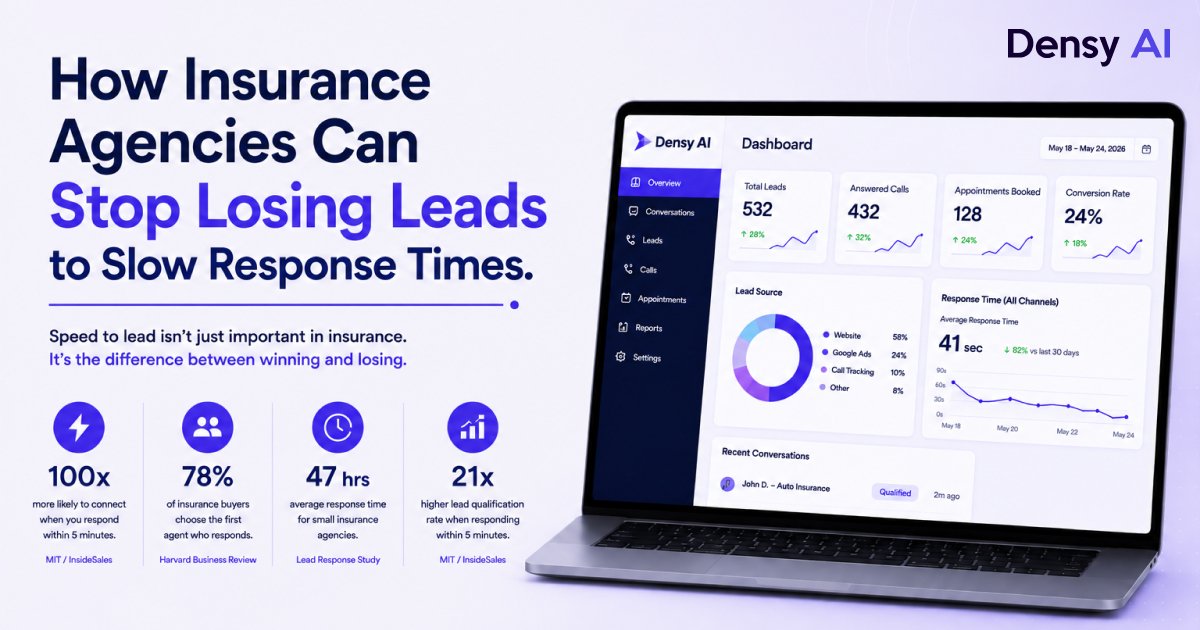
78% of insurance buyers go with the first agency that responds to their enquiry. The average agency takes 47 hours to follow up. The gap between those two numbers is where most insurance lead revenue disappears — and it is entirely fixable.
The Lead Response Problem Most Insurance Agencies Don't Know They Have
Ask any insurance agency principal how quickly their team follows up on new leads and you will hear some version of the same answer: quickly, same day, as soon as we can. Ask them to pull the actual timestamps from their CRM and the picture is almost always different. The gap between what agencies believe their response time is and what it actually is tends to be measured not in minutes, but in hours — sometimes days.
This is not a failure of intention. Producers are busy people. They are managing renewals, handling claims queries, on calls with existing clients, and generally doing the work that keeps the agency running. When a new web lead arrives or a missed call notification appears, it joins a queue of things that need attention — and in that queue, it competes with obligations that feel more immediate.
The problem is that insurance leads do not wait in queues. A prospect who submitted a quote request at 2pm on a Tuesday is not thinking about your agency at 9am the following morning. They have already bought a policy — from whoever responded first. The revenue was not lost because the producer forgot. It was lost because the response system was built around human availability rather than buyer behaviour.
What the Data Says About Insurance Lead Response Times
The research on lead response time and conversion rates in insurance is unusually consistent. Across multiple studies and across different agency sizes and lines of business, the same pattern emerges: speed determines outcome far more than any other variable in the lead-to-sale pipeline.
The 47-hour average response time is the figure that most agency owners find genuinely surprising — because it does not match their perception of how their agency operates. It reflects the aggregate: leads that arrive on Friday afternoon, enquiries that come in via web form overnight, missed calls that fall into a producer's voicemail on a Wednesday when they are out on client visits. Every one of those interactions adds to the average.
The five-minute window is the most operationally important number. A study published in the Harvard Business Review found that sales teams who attempted to contact leads within one hour were seven times more likely to qualify the lead than those who waited two hours. Research specific to insurance puts the multiplier even higher — leads contacted within five minutes are up to 21 times more likely to convert than those contacted after 30 minutes. The decay curve is steep and it begins almost immediately after the enquiry arrives.
44% of insurance leads receive zero follow-up after their initial enquiry. Nearly half of all the marketing spend, referral effort, and brand investment that generated those leads produces nothing — not because the leads were bad, but because no one contacted them.
What Happens to a Lead Every Minute You Don't Respond
Insurance lead decay is not a gradual process. It is a cliff. Understanding exactly what happens in the minutes and hours after a lead arrives makes the urgency of first-response automation concrete — and makes the cost of delay impossible to ignore.
- 0–1mThe lead is fully engaged. The prospect has just submitted a quote request or hung up the phone. Their intent is at its peak. They have your agency in mind, they are ready to talk, and they are waiting for a response.
- 5mThey start exploring alternatives. No response after five minutes signals that your agency may not be responsive. Most buyers quietly open a second browser tab and begin looking at the next result in their Google search.
- 30mA competitor is already in conversation. Any agency that responded within five minutes has had a full qualifying conversation, built rapport, and likely booked a follow-up call. Your lead is now their prospect.
- 2hrConversion probability has collapsed. Research puts conversion likelihood at under 10% for leads contacted after two hours — compared to over 40% for those contacted within one minute. The same lead is effectively a different lead.
- 24hr+The policy has already been sold — to someone else. Agencies that contact leads the next business day are not following up on warm leads. They are calling people who have already made a decision and feel no particular obligation to take the call.
The window that separates a won lead from a lost one is almost always the first five minutes after the enquiry arrives. Everything that happens after that is catching up — and the data shows that catching up rarely works. The only strategy that consistently converts insurance leads at scale is responding before the prospect moves on.
The Three Biggest Causes of Slow Lead Response in Insurance Agencies
Slow lead response is not usually the result of a single failure. It is almost always the combined output of three structural problems — each of which compounds the others.
1. Manual follow-up that depends on individual producers
In most insurance agencies, following up on a new lead requires a producer to notice it, decide to act on it, find the contact details, and make the call — all while managing their existing book of business. When producers are busy with renewals, claims queries, or existing client meetings, new leads sit. There is no system that guarantees action within five minutes; there is only individual initiative. Individual initiative is not a repeatable process.
2. After-hours and weekend lead gaps
Insurance leads arrive around the clock. A homeowner shopping for home insurance does it on a Sunday evening. A new business owner looking for commercial coverage searches at 10pm after their kids are in bed. These are high-intent, motivated buyers — and they are submitting enquiries at exactly the times when no one in the agency is there to respond. By Monday morning, those leads have had 36 to 60 hours to find another agency that handles enquiries outside business hours.
3. CRM data that is captured but never actioned
Many agencies have invested in a CRM and lead management platform. The data is there — lead source, contact details, coverage interest, enquiry time. What is missing is the automated trigger that turns that data entry into an immediate outbound contact. A lead sitting in a CRM with "New" status is not being followed up. It is being stored. The gap between capture and contact is where most insurance revenue is lost.
What these three causes share is that none of them are solved by telling producers to try harder or move faster. They are structural problems that require structural solutions — systems that remove human availability as a dependency in the first-response process.
How to Build a Lead Response System That Never Sleeps
Fixing insurance lead response time requires removing human availability from the critical path of first contact. The system needs to be able to respond to a lead at 11pm on a Saturday with the same speed and quality it delivers at 10am on a Tuesday. Here is the architecture of a response system that achieves that consistently.
- 1Capture every lead into a single, actionable queue. Web forms, portal submissions, inbound calls, and referral contacts should all route to the same place in real time — not to individual producer inboxes where they can sit unnoticed. Centralised lead capture is the foundation everything else builds on.
- 2Automate the first response within 60 seconds. The moment a lead enters the queue, an automated SMS and email should go out — acknowledging the enquiry, introducing your agency by name, and offering the prospect a clear next step (book a call, reply with their availability, or ask a question). This response must be fast, personal, and professional. Generic auto-responders that obviously look automated do not achieve the same result.
- 3Run a structured multi-touch follow-up sequence, not a single contact. Most leads do not convert on the first touch. A well-designed follow-up sequence contacts the lead across voice, SMS, and email over the first 72 hours — with messaging that adjusts based on engagement signals. Leads that reply at any point move into a conversation flow; leads that do not are flagged for a personal producer call at a defined threshold.
- 4Measure response time by lead source and producer. You cannot improve what you cannot see. Tracking actual first-contact time by source (web form vs. inbound call vs. referral) and by producer creates accountability and identifies where the biggest gaps are. Most agencies that implement this measurement are surprised by what the data shows.
How Automation Closes the Response Gap Permanently
The challenge with manually implementing a five-minute response standard is that it requires someone to be monitoring leads and ready to act at all times — which is not operationally viable for most agencies. The practical solution is automation that handles the first response entirely, without waiting for a producer to be available.
An AI answering service answers inbound calls within two rings — at any hour, on any day — and conducts a structured intake conversation. It identifies the caller's coverage interest, collects key qualifying information, and books a consultation directly into the relevant producer's calendar. The producer receives a complete qualification summary before their first personal conversation, so the call they do have is focused on closing, not gathering basic information.
For leads that arrive through web forms or portals, automated insurance lead follow-up sequences trigger the moment the lead enters the CRM — sending an immediate, personalised SMS and email within 60 seconds, followed by structured touchpoints across the next 72 hours. Leads that respond at any point move into an AI-handled conversation that qualifies them and books the appointment. Leads that do not respond after the full sequence are flagged as cold and escalated to a producer for a personal call.
For calls that are missed despite having an answering system in place, missed call recovery sends an automated SMS to the caller within 60 seconds — re-engaging the prospect before they call a competing agency. Combined, these three layers eliminate the response gap entirely. No lead is left uncontacted because a producer was busy. No after-hours enquiry sits until the next business day. Every new lead gets a professional, immediate response — regardless of when it arrives or how many calls are already in progress.
The agencies winning the speed-to-lead race are not the ones with the fastest producers. They are the ones that removed the producer from the first-response loop entirely and let automation handle it — so their producers spend their time on conversations that are already qualified, already warm, and already expecting the call.
For a deeper look at what this looks like in practice for insurance agencies specifically, see how Densy AI works for insurance agencies. For the broader data on what slow lead response costs across service businesses, read our analysis on the cost of missed calls.
Frequently Asked Questions
How fast should insurance agents follow up with leads?
Research consistently shows that the optimal window for first contact is within five minutes of a lead arriving. Agencies that respond in under five minutes are 21 times more likely to qualify that lead than those that respond after 30 minutes. Any response time beyond one hour should be considered critical — the majority of those leads have already engaged with a competing agency.
What is the average insurance agency lead response time?
Studies of insurance agency lead handling consistently show that the average agency takes between 24 and 47 hours to make first contact with a new lead. This is dramatically out of step with buyer behaviour — most insurance leads make a purchasing decision within hours of their initial enquiry, not days.
Why do insurance leads go cold so quickly?
Insurance buyers are comparison shopping at the moment of enquiry. They typically reach out to two or three agencies simultaneously and go with whichever responds first with a relevant, professional reply. The buying intent that drives the initial enquiry is time-bound — waiting even 30 minutes allows competitors to establish a relationship first, and once a prospect is engaged with another agent, the probability of switching back is very low.
What is the best way to automate lead follow-up for an insurance agency?
The most effective approach combines two layers: an AI answering service that responds to inbound calls within seconds, and an automated multi-touch follow-up sequence — triggered the moment a new lead arrives — that sends an immediate SMS and email, followed by structured voice and message touchpoints over the next 72 hours. This eliminates human delay entirely while keeping every interaction professional and on-brand.
Does automated lead follow-up actually work for insurance?
Yes. Insurance agencies using automated first-response systems consistently report a 30–50% improvement in lead contact rates compared to manual follow-up. The impact is highest on after-hours and weekend leads — enquiries that previously went cold overnight are now contacted within 60 seconds, dramatically increasing the number of conversations that actually happen.
How much revenue does slow lead response cost an insurance agency?
The cost depends on your lead volume, average policy value, and commission structure. For a mid-size agency receiving 100 leads per month with a 20% close rate and an average annual premium of $1,800: improving contact rate by 30% translates to 6 additional closed policies per month — roughly $3,240 in additional monthly commission at a 15% rate, or $38,880 per year. Agencies with higher lead volumes or policy values see proportionally larger gains.
Ready to close the gap?
See How Densy AI Automates Lead Follow-Up
for Insurance Agencies
Every new lead contacted within 60 seconds. Every inbound call answered within two rings. Every missed call followed up automatically — so your producers only spend time on leads that are already qualified and ready to talk.
No commitment required. Live in 24–48 hours.