
AI Recruiter
How AI Is Transforming Staffing Agencies and High-Volume TA Teams
“AI recruiter” is the fastest-growing term in staffing software — searches are up 84% quarter over quarter. But what does an AI recruiter actually do? Where does it fit alongside human recruiters? And what makes the difference between an AI recruiter that ships value in a week and one that becomes a shelfware experiment? Here is a plain- English answer for staffing agency owners, TA leaders, and recruiting operators.
What Is an AI Recruiter?
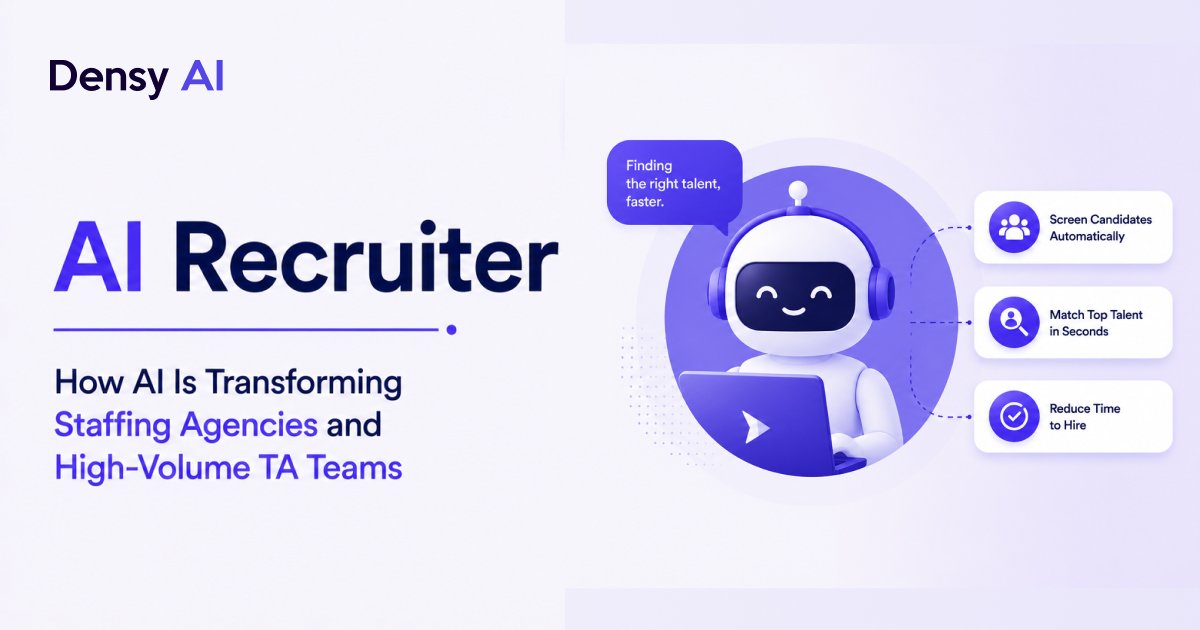
An AI recruiter is software that engages candidates the moment they apply or call, pre-qualifies them with the questions your recruiters would ask, schedules interviews directly into recruiter calendars with ATS write-back, sends reminders to cut no- shows, and runs reactivation campaigns against silver-medalist and dormant talent pools.
Put another way: an AI recruiter does the first-response and scheduling work — the high-volume, time-sensitive, routine part of recruiting — so your human recruiters focus on the candidates who are ready for a real conversation. This distinction matters because most staffing agencies and in-house TA teams are not losing offers to bad closers. They are losing offers to slow response times. Industry research shows that 49% of candidates disengage when recruiter response takes more than 24 hours1. An AI recruiter closes that gap by responding in seconds — every time, every day, at any hour.
What Does an AI Recruiter Actually Do?
A well-built AI recruiter typically handles five things.
1. Candidate first-response. The moment a candidate applies, calls, or fills out a form, the AI engages — across SMS, voice, and email. Not a generic auto-reply. A real conversation that acknowledges the specific role, asks a few qualifying questions, and sets the next step. This alone typically doubles response rates versus recruiter-driven manual outreach.
2. Pre-qualification. The AI asks the intake questions your recruiters would ask — role of interest, availability, work authorisation, salary expectation, location, must-have skills. Answers are structured into the candidate record so recruiters see the qualified summary instead of digging through transcripts.
3. Interview scheduling. The AI reads live availability from each recruiter's calendar and offers the candidate real slots during the conversation. Multi-recruiter routing rules direct candidates to the right person by req, client, or persona. Scheduled events sync back to the ATS with the meeting link included.
4. Reminder and no-show recovery. Interview reminders fire automatically at configurable intervals — typically 24 hours and 1 hour before. Candidates confirm or reschedule by replying. When a candidate cancels or no-shows, the slot is immediately offered to a waitlisted candidate.
5. Silver-medalist reactivation. Past candidates who reached late-stage interviews or received offers but did not join are segmented and re-engaged when new similar roles open. This is often the highest-ROI capability because silver-medalists are already warm — they know your firm, they know the role type. Response rates on silver-medalist campaigns often beat fresh sourcing.
See our full AI recruiter for staffing agencies page for the vertical-specific integrations and workflow depth.
Does an AI Recruiter Replace a Human Recruiter?
No. This is the most common misconception and worth clearing up directly.
Recruiting activity splits roughly into two buckets. The first is the high-volume, time-sensitive, routine work — first-response, screening questions, scheduling, reminders, follow-ups. Depending on the desk, this consumes 60 to 80 percent of a recruiter's day. It is exactly the work AI does well: repetitive, structured, and fast.
The second bucket is the judgment work — assessing cultural fit, closing candidates on offers, running client relationships, negotiating, handling difficult interview conversations, and reading the room in real time. This remains firmly with human recruiters. AI cannot close a $200,000 candidate who is weighing three offers. A human recruiter who is not buried under scheduling calls, however, absolutely can.
Most staffing agencies deploying AI recruiters use them to make existing recruiters more productive — not to reduce headcount. Typical results after 30 days: recruiters handle 40–60% more candidate pipeline, time-to-fill drops meaningfully, and offer acceptance improves because recruiters spend more time on the candidates who matter.
Where Does an AI Recruiter Fit for Staffing Agencies vs In-House TA?
Both buyers get value from an AI recruiter, but the emphasis is different.
Staffing agencies care most about candidate volume and speed. Every hour a candidate waits is an hour a competing agency gets to them first. AI recruiters shine here because the first- response speed differential is immediate and measurable. The multi-client / multi-recruiter routing matters — a good AI recruiter supports different intake rules and different branded experiences per client account.
In-house TA teams care most about time-to-fill and candidate quality-of-experience. The recruiter workload is smaller but each hire matters more. AI recruiters here focus on cutting interview scheduling time, catching candidates who slip out of the funnel, and reactivating silver-medalists when new reqs open — often producing better hires than a fresh sourcing campaign.
Both buyer types benefit from ATS write-back. Whether you run Greenhouse or Lever or Bullhorn or Workday, the AI recruiter should feed the ATS, not replace it.
What Should You Look for When Evaluating an AI Recruiter?
Four criteria matter more than the marketing pages suggest.
1. ATS-native write-back. The AI recruiter must write candidate transcripts, dispositions, and scheduled events back to your ATS automatically. If it does not, you end up with two candidate records and a data-entry job. Ask specifically about your ATS.
2. Multi-recruiter routing. Every recruiter needs their own pipeline, calendar rules, and disposition logic. A single shared inbox does not scale past three recruiters. Look for per-recruiter routing by req, by client, and by candidate persona.
3. Multi-language candidate conversations. Global staffing firms and US agencies alike lose candidates when the AI is English-only. In the US, a meaningful share of hourly and skilled- trade candidates prefer Spanish. Globally, staffing firms need Mandarin, Hindi, Portuguese, Arabic, French, and more. Look for a platform that handles every major world language with the same intake quality and ATS write-back, not just an English-first tool with Spanish bolted on.
4. Setup time and pre-configuration. Enterprise platforms often take months to configure workflows. Purpose-built AI recruiters ship with pre-configured intake flows, scheduling logic, and ATS mappings that go live in days. Ask for a published setup timeline.
Frequently Asked Questions
What is an AI recruiter?
An AI recruiter is software that engages candidates the moment they apply or call, pre-qualifies them with the questions your recruiters would ask, schedules interviews directly into recruiter calendars with ATS write-back, sends reminders to cut no-shows, and runs reactivation campaigns against silver-medalist and dormant talent pools. It does the first-response and scheduling work so your recruiters focus on the candidates who are ready for a real conversation.
Does an AI recruiter replace a human recruiter?
No. An AI recruiter handles the routine first-response, pre-qualification, and scheduling work — typically the 60 to 80 percent of recruiting activity that is high-volume and time-sensitive but does not require human judgment. The complex work (making offers, closing candidates, running client relationships, difficult interview conversations) remains with human recruiters. Most staffing agencies use AI recruiters to make their existing recruiters more productive, not to reduce headcount.
Does an AI recruiter integrate with our ATS?
A properly built AI recruiter integrates with the major applicant tracking systems — Greenhouse, Lever, Bullhorn, Workday, iCIMS, JobAdder, Workable, Ashby, SmartRecruiters, and others. Every candidate transcript, disposition, and scheduled event syncs back to the candidate record automatically. The ATS remains the source of truth; the AI recruiter feeds it.
How does an AI recruiter handle interview scheduling?
The AI reads availability from each recruiter's Google or Outlook calendar — respecting buffers, working hours, and existing meetings — and offers the candidate real interview slots during the conversation. Multi-recruiter routing rules direct each candidate to the right person by req, client, or persona. Scheduled events sync back to the ATS. Zoom or Teams links are generated automatically.
Can an AI recruiter reactivate silver-medalist candidates?
Yes — and this is often the highest-ROI use case. Silver-medalists are past applicants who reached late-stage interviews but did not join. Every staffing agency and TA team has hundreds of them sitting in the ATS. The AI segments them by role family, location, or last engagement and runs personalised reactivation campaigns across SMS, email, and outbound voice when new similar roles open. Response rates on silver-medalist outreach are often higher than fresh sourcing.
How much does an AI recruiter cost?
AI recruiter pricing varies by candidate volume, integrations, and outbound campaign scope. Most vendors use custom pricing with a flat monthly subscription rather than per-candidate or per-conversation fees. Expect the pricing conversation to start with your monthly application volume and the ATS you use. Public pricing is rare in this category.
Sources
- Indeed Talent Attraction Study — candidate disengagement rates when recruiter response exceeds 24 hours.
See what an AI recruiter looks like configured for your desk
Densy AI is an AI recruiter for staffing agencies and high-volume TA teams. Book a demo and see how it would run against your ATS, your recruiters' calendars, and your client routing rules.